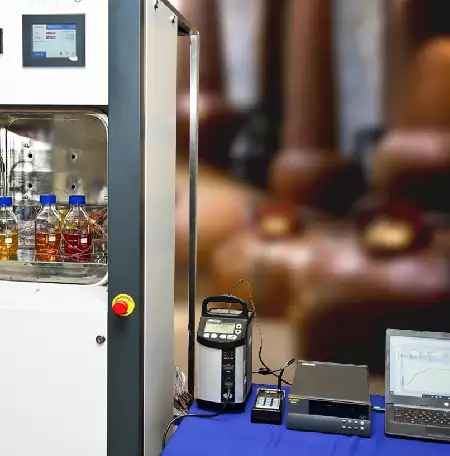
It is important that the food industry ensures that its products meet the highest standards of microbiological quality. A hazard analysis and critical control study will invariably identify the autoclave – for product sterilisation or quality control laboratory testing – as a potential risk. A failure of product sterilisation clearly has far reaching consequences but a failure of the laboratory steriliser can produce spurious results causing unnecessary product wastage.
When it comes to using steam for sterilisation, it is critical to know that the correct pressures and temperatures have been reached, and that they have been held for long enough to ensure the total destruction all microorganisms, bacteria and spores. This means that the autoclave instruments that control your laboratory steriliser must be producing accurate readings.
Check your equipment - Calibration
Calibration is about checking that the autoclave instruments read accurately by comparison against a known standard, and that the chamber reaches the required temperature for the required time. This testing methodology should be carried out using the protocols set out in ISO/IEC 17025:2017. The test can be carried out at a number of different sterilisation temperatures and times depending on the organisation’s requirements, and confirms that the machine has been calibrated in accordance with UKAS standards by an accredited calibration laboratory. Upon successful completion, the laboratory will receive a certificate of calibration. However, a successful calibration only confirms that the instruments and controls are operating correctly: it does not ensure that the loads placed in the autoclave are actually achieving the specified temperature and time. This requires validation.
Check the results - Validation
Multipoint Validation is a more detailed procedure which records temperature readings at 12 or more points within a specific laboratory’s load over a specified time. Steam penetration and air removal is of key importance with these tests and so tests are carried out under worst-case conditions which would be an example of the largest load likely to run.
Analysing the results from multipoint testing enables a validation engineer to set up dedicated sterilisation programmes for the loads; this is advantageous when “difficult” items are to be sterilised. Once testing is complete and the cycles have been set up, the engineer will issue a certified test report detailing all the results from testing including details of cycle times and temperatures, along with photographs which show how the contents have been loaded into the chamber to ensure that the operators load in the same way each time. Such validation reports provide continuity, particularly when an autoclave has different users, and ensure reliability and correct use of a steriliser.
Multipoint validation tests should be completed at regular intervals using a UKAS accredited testing laboratory. The protocols set out in ISO/IEC 17025:2017 should be adhered to.
Reliance on Compliance
The food industry is heavily regulated, and failure to meet sterility requirements can have serious repercussions. Regular calibration is a clear routine necessity, but validation ensures compliance. It establishes documented evidence that shows a high degree of confidence that the sterilisation process will be performed consistently. Even if your autoclave is brand new it is your responsibility to ensure that it operates as intended. Validation is the key to meeting this responsibility and regular testing by an accredited company is recommended as good practice.