STEAM FITS: The 9 Things to Check When Selling an Autoclave
Steam sterilization works on one fundamental principle: steam must physically touch every surface of every item being sterilized. For this to happen reliably, the autoclave must be the right model for the load, correctly installed, and used by an operator who understands how steam behaves. STEAM FITS is the framework that covers everything you need to establish before recommending an autoclave — and everything a customer needs to know to get consistent, validated results from it.
S — Sterilization Purpose

What are they sterilizing?
Start every sales conversation by identifying the application. The type of load being sterilized determines the autoclave specification more than any other single factor. Before discussing chamber size, configuration, or price, always establish what the customer is actually processing — because a site sterilizing liquid culture media has fundamentally different requirements from one disposing of clinical waste or sterilizing wrapped surgical instruments.
Sales takeaway: The load defines the machine. Always start here.
Fluids and Liquids
Liquid sterilization — most commonly culture media, reagents, or other aqueous solutions — is one of the most frequently encountered use cases in laboratory settings. Liquids present a specific challenge: they have a high thermal mass and heat more slowly than the surrounding air in the chamber. This means the chamber reaching its target temperature does not confirm that the liquid inside the bottles has done the same. Liquid loads therefore always require longer cycle times than equivalent solid loads, and should always be run with a load temperature probe (see I — Internal Liquid Temperature) to ensure the sterilization hold time only begins once the liquid itself is at the required temperature.
Waste and Discard
Laboratory or clinical waste is another common load type. It is important to distinguish between plastic waste and liquid waste, as these have different cycle requirements and containment needs. The customer should also clarify whether waste is being autoclaved prior to safe disposal (rendering it non-hazardous) or for some other purpose, as this may affect cycle validation requirements. Note that for clinical waste, local regulatory requirements may apply.
Instruments
Wrapped and unwrapped instruments behave differently in the autoclave. Unwrapped instruments in an open tray are relatively straightforward, as steam can reach all surfaces directly. Wrapped instruments introduce an air-removal challenge: the wrapping material traps air against the instrument surface, and that trapped air prevents steam from making contact. Wrapped loads typically require a pre-vacuum or pulsed vacuum cycle to draw air out before steam is introduced. Establishing whether instruments are wrapped or unwrapped is therefore a key specification question.
Fabrics, Tubing, and Pipette Tips
Textiles, flexible tubing, and pipette tips all share the same problem: they trap air. Fabrics hold air in their fibres; tubing holds it in the lumen; pipette tips trap it in narrow cavities. All of these load types typically require a vacuum-assisted cycle — either a single pre-vacuum stage or a pulsed fractionated vacuum — to evacuate air before steam is admitted. If the customer is processing any of these materials, a gravity-displacement cycle is unlikely to be adequate, and this should be factored into the specification from the outset.
Utensils and General Lab Equipment
General lab glassware, utensils, and equipment are often straightforward to sterilize, but complex geometries deserve attention. Hollow items, items with blind recesses, or instruments with hinged or jointed sections can all trap air even in a gravity cycle. If the customer has unusual items in their load, it is worth asking about the geometry and considering whether a vacuum-assisted cycle would give more reliable results.
Mixed Loads
Many laboratory customers do not run a single clean load type — they run whatever needs sterilizing that day, which may be a combination of liquids, instruments, and waste. When a site runs mixed loads, the programme requirements of the most demanding load type set the minimum specification for the whole machine. A site that runs both wrapped instruments and liquid media, for example, needs an autoclave capable of vacuum-assisted cycles (for the instruments) and liquid programmes with a load probe (for the media). Establishing the full range of load types at the outset prevents under-specification.
Jump to the STEAM FITS Checklist
T — Typical Load

What is the average load volume, size, weight, and shape?
Once the load type is established, the next question is about scale and frequency. Chamber size is not simply a matter of picking the largest option — the right chamber is one that comfortably accommodates a typical run without unnecessary overhead, while having enough capacity to handle peak throughput without creating a processing bottleneck.
Sales takeaway: Do not oversize or undersize. Match the machine to real usage.
Volume and Size
Ask the customer to describe a typical autoclave run in concrete terms: how many bottles, what sizes, how many trays of instruments, how many waste bags. This gives a working load volume that can be matched to available chamber sizes. A useful rule of thumb is to aim for a chamber that can be comfortably loaded to around 70–80% capacity on a typical run, leaving headroom for variation without wasting energy on an oversized chamber.
Weight and Shape
The weight and shape of the load matters for both practical and technical reasons. Heavy loads — particularly large quantities of liquid — require appropriate shelving and load support. Irregularly shaped loads may affect steam circulation within the chamber. Very large or heavy individual items may influence the choice between horizontal (front-loading) and vertical (top-loading) configuration, since horizontal units typically offer better access for heavy or awkward loads.
Frequency of Use
How many cycles does the customer need to run per day or per week? A high-throughput laboratory running multiple cycles per day has different requirements from a small site running a handful of cycles per week. High-frequency use increases wear on seals, elements, and control components, making the choice of model and the service contract more significant. It may also point towards a larger chamber to allow fewer, larger runs rather than many smaller ones.
Configuration: Horizontal vs Vertical
The answers to the above questions will indicate whether a horizontal (front-opening door) or vertical (top-opening lid) configuration is more suitable. Vertical units have a smaller footprint and suit smaller loads in constrained spaces. Horizontal units offer larger capacity and are generally better suited to high-throughput sites, larger or heavier loads, and applications requiring a double-door pass-through configuration. For horizontal units, also confirm the door opening style: does the door open outward on a hinge, or does it slide up or down? This determines the clearance space needed in front of the unit.
Jump to the STEAM FITS Checklist
E — Entry and Space

Can the unit physically get into position, and is there enough working space around it?
The room matters as much as the autoclave. A common and entirely avoidable problem is specifying an autoclave that cannot be delivered to its intended location, or one that fits in the space on paper but leaves no room for the operator to work safely and efficiently. Both of these checks must be done before order confirmation.
Sales takeaway: The room matters as much as the autoclave.
Physical Access and Delivery Route
Measure the entire delivery route from building entrance to final position: doorway widths, corridor widths, any right-angle turns, and lift dimensions if the unit needs to go to an upper floor. For large floor-standing autoclaves, check whether door frames or other fixtures will need to be temporarily removed. In some older buildings or converted laboratory spaces, the delivery route is the binding constraint on which model can be installed.
Floor Space and Clearance
The autoclave's footprint is only part of the space requirement. Allow for:
- Clearance on all sides for ventilation and access during servicing
- Door swing or lid-opening clearance (a front-opening door needs clear space equivalent to the door depth in front of the unit)
- Operator working space for loading and unloading — particularly relevant for heavy liquid loads or large waste bags that may need to be maneuvered with a trolley
Door Configuration and Workflow
For vertical units, confirm there is adequate overhead clearance for the lid to open fully. For horizontal units with slide-up or slide-down doors, confirm the door track will not conflict with overhead storage or ceiling-mounted services. For double-door pass-through units, confirm that both sides of the autoclave have matching access and that the workflow between clean and dirty sides is practical for the operators using it.
Jump to the STEAM FITS Checklist
A — Available Utilities

What electrical supply, drainage, and water connections are on site?
Confirm utilities early to avoid costly delays. Utility mismatches are among the most common causes of delayed or problematic installations. Every required service must be confirmed before order — retrofitting a 3-phase electrical supply or adding a floor drain after the autoclave has been delivered is time-consuming, expensive, and entirely avoidable.
Sales takeaway: Confirm utilities early to avoid delays.
Electrical Supply
Confirm the available electrical supply at the intended installation point: voltage, number of phases, and available circuit capacity. Smaller bench-top autoclaves typically run on a standard single-phase supply. Larger floor-standing units — particularly those with fast-heat or high-power heating elements — often require 3-phase, 415V power. If the site does not currently have 3-phase power at the required location, an electrician will need to run a new supply before installation. This should be factored into the project timeline and cost.
Water Supply
Confirm whether the site has mains water available at the installation point, and whether the connection will be manual fill or autofill. Manual fill means the operator adds water to the autoclave's reservoir before each cycle — suitable for lower-frequency use. Autofill connects the autoclave directly to the mains water supply and fills automatically, which is strongly recommended for high-frequency or unattended operation. Also confirm whether the site has access to a treated water supply (softened, reverse osmosis-treated, or deionised), which is always preferable to untreated mains water (see M — Minerals in the Water).
Drainage
A floor-level drain with an open, free discharge point is the ideal drainage arrangement for an autoclave. Specifically, a DN54 floor drain capable of accepting hot condensate without back-pressure. Check that the drain is genuinely free-discharge — some drainage systems have back-pressure restrictions or are connected to systems where hot liquid discharge is problematic. Condensate and effluent must drain freely after each cycle; a restricted drain can cause cycle faults and potential overflow.
Ventilation
Autoclaves produce heat and steam during the exhaust and venting phase of each cycle. Confirm that the room is adequately ventilated and that exhaust steam will not affect nearby equipment, personnel, or building fabric. In enclosed spaces, additional ventilation or a steam condenser may be necessary.
Jump to the STEAM FITS Checklist
M — Minerals in the Water

How hard is the local water supply, and what is the pH?
Water quality directly affects lifespan and reliability. Scale build-up from hard water progressively degrades heating elements, clogs solenoid valves, coats chamber walls, and accelerates corrosion of internal components. In severe cases, hard water damage can void the manufacturer's warranty if it is shown that the water supply was outside the specified operating range.
Sales takeaway: Water quality directly affects lifespan and reliability.
Acceptable Water Quality
The autoclave can operate satisfactorily with normal untreated mains water, provided the water hardness is below 50 parts per million (ppm) and the pH is neutral. These are the thresholds within which scale formation is slow enough that regular descaling maintenance can keep the autoclave in good condition.
If local water hardness exceeds 50 ppm, a water softener unit must be installed upstream of the autoclave's water supply. This is not an optional upgrade — it is a required part of the installation in hard water areas. The cost of the softener and its installation should be included in the proposal from the outset.
Treated Water Options
Where the site has access to a treated water supply — whether that is softened water, reverse osmosis (RO)-treated water, or deionised (DI) water — this should always be used in preference to untreated mains water. Treated water significantly extends the service life of the autoclave, reduces the frequency of descaling maintenance, and produces cleaner, drier steam which improves sterilization performance.
How to Check Water Hardness
Most mains water suppliers publish water hardness data by postcode or regional supply zone. This is the quickest way to establish whether a softener will be required. If the site is in an area of known water hardness variability, or if the customer is unsure, a simple water hardness test kit can provide an immediate reading at the point of installation.
Jump to the STEAM FITS Checklist
F — Free Flowing Steam
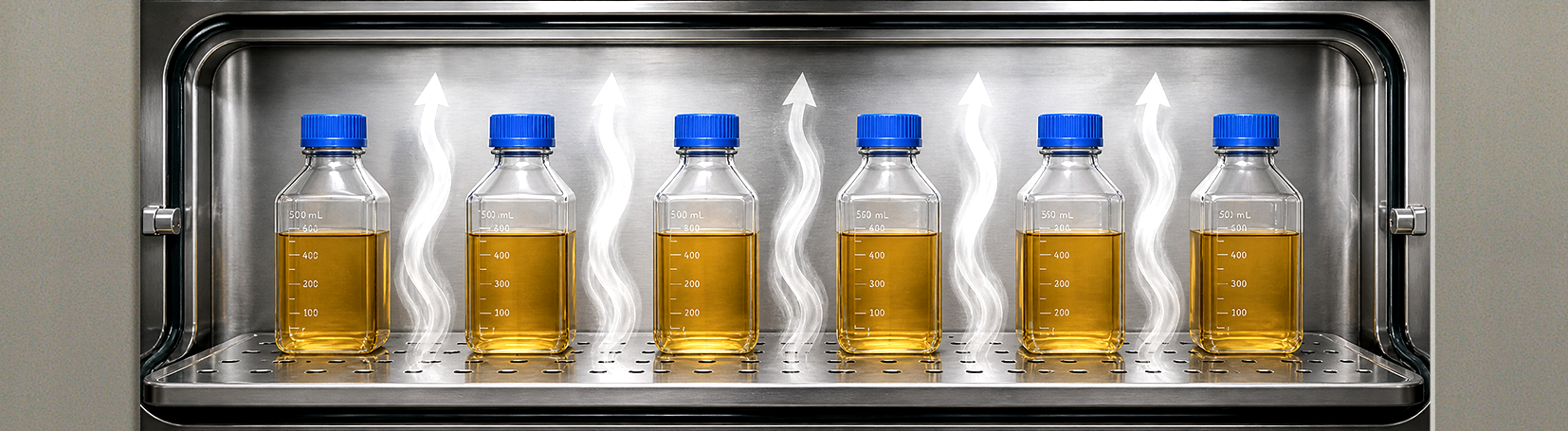
Can steam circulate freely throughout the entire load?
Poor loading leads to poor sterilization. The fundamental principle of steam sterilization is that steam must make physical contact with every surface of every item in the load. An autoclave can only sterilize what steam can reach. Loading technique is therefore as important as the autoclave itself — and it is something that the customer's operators need to understand and apply consistently from the very first cycle.
Sales takeaway: Poor loading leads to poor sterilization.
Use Trays and Baskets
All material to be sterilized must be placed on trays or in stainless steel baskets, not placed directly on the chamber floor or stacked flat in piles. The purpose of trays and baskets is to elevate items and create space for steam to circulate freely underneath and around them. Items placed directly on the floor of the chamber create a contact zone where steam cannot reach the underside, leaving those surfaces unsterilized.
Use Load Support Plates
Load support plates (or perforated shelving) further elevate items within the chamber and ensure that steam can circulate beneath the base of the load as well as around it. This is particularly important for large or heavy items that might otherwise sit flat and seal against the tray surface.
Loosen Bottle Caps
Media bottles, sample bottles, and any other containers with screw caps must always have their caps loosened by approximately a quarter turn before being placed in the autoclave. A sealed container traps the air inside: that air cannot be displaced by steam, preventing equalisation of pressure and temperature within the bottle. Beyond the sterilization failure this causes, a sealed glass bottle in a pressurised steam environment is a significant safety risk — pressure inside the bottle can build to the point of shattering.
Open Waste Bags
Waste bags must be left open and untied before autoclaving, and should be placed in stainless steel discard bins rather than simply standing in the chamber. A sealed waste bag traps air inside, creating a pocket that steam cannot penetrate — meaning the waste inside is not sterilized. Additionally, the sealed bag can inflate under pressure and rupture, distributing the contents across the chamber interior.
Jump to the STEAM FITS Checklist
I — Internal Liquid Temperature
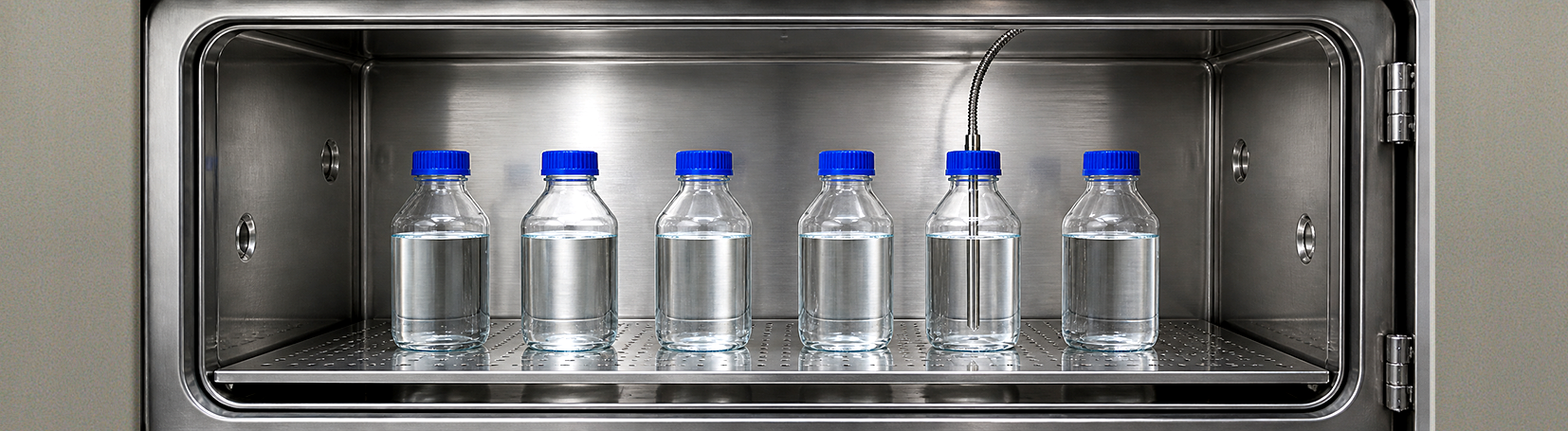
How do you confirm that the liquid itself has reached sterilization temperature?
Liquids heat slower than the chamber — the chamber reaching temperature is not enough; the load must too. When an autoclave reaches its set sterilization temperature, the steam within the chamber is at that temperature — but the liquid inside bottles and containers within the load may still be significantly cooler, because liquid has a much higher thermal mass than air and takes longer to heat. Running the sterilization hold time from the point at which the chamber reaches temperature, rather than the point at which the load itself reaches temperature, risks completing a cycle in which the liquid has never actually been sterilized.
Sales takeaway: The chamber reaching temperature is not enough — the load must too.
Why Liquid Loads Take Longer
The larger the volume of liquid in a container, the longer it takes to reach sterilization temperature. A 100 ml bottle heats relatively quickly; a 5 litre bottle may lag the chamber temperature by many minutes, even in a well-sealed autoclave running an appropriate cycle. Standard cycle times that work reliably for solid or instrument loads will often be inadequate for large-volume liquid loads unless they have been specifically validated for that load size and type.
Load Sensed Process Timing (LSPT)
The solution to this challenge is Load Sensed Process Timing (LSPT), sometimes also referred to as a load temperature probe or reference probe. A temperature probe is placed directly into the liquid load — either into a reference bottle of equivalent volume filled with the same liquid, or directly into a bottle within the actual load. The autoclave's control system monitors this probe and only begins counting the sterilization hold time once the probe confirms that the liquid itself has reached the required sterilization temperature.
LSPT removes the uncertainty from liquid sterilization. It ensures that every cycle is valid regardless of load volume, starting temperature, or minor variation in chamber performance. For any customer regularly processing liquid loads, LSPT should be recommended as standard rather than as an optional extra.
Practical Guidance
The reference bottle used for LSPT should be filled with the same liquid as the actual load and should match the volume of the largest container in the load. Using a smaller reference bottle will result in the timer starting before the larger bottles in the load have reached temperature, giving a false indication of a completed sterilization. This is a detail that is easy to get wrong and worth explaining clearly to the customer's operators.
Jump to the STEAM FITS Checklist
T — Trouble Spots

What common mistakes do operators need to avoid?
Most problems are caused by operator error, not the machine. The majority of autoclave sterilization failures are not caused by equipment malfunction — they are caused by preventable mistakes in loading, cycle selection, or maintenance reporting that result in incomplete sterilization or, in some cases, damage to the autoclave itself. A well-informed customer is significantly less likely to experience these problems.
Sales takeaway: Most problems are caused by operator error, not the machine.
Unsuitable Containers
Not all containers are suitable for autoclaving. The key question is whether steam can reach all interior surfaces. Narrow-necked vessels, containers with complex internal geometry, items placed upside down with their opening sealed against a tray, and tightly packed arrangements that prevent steam from circulating between items are all common causes of incomplete sterilization. If the customer is autoclaving items with unusual geometry, it is worth discussing how those items should be positioned and whether additional measures — such as rotating them mid-cycle or using a vacuum-assisted programme — are warranted.
Sealing Bags Before Autoclaving
This is one of the most frequently encountered operator errors with waste loads. When a waste bag is sealed — whether tied, cable-tied, or heat-sealed — before being placed in the autoclave, the air trapped inside the bag cannot be displaced by steam. The bag may be surrounded by saturated steam, but the interior remains a pocket of trapped air in which the waste is not sterilized. Operators must be clearly instructed: waste bags go into the autoclave open and untied, every time.
Overfilling Media Bottles
Filling media bottles too close to the top leaves insufficient headspace for liquid expansion during the heating phase of the cycle. As the liquid approaches sterilization temperature it expands and, in a sealed or insufficiently vented bottle, will overflow. Spillage of media or other liquids into the autoclave chamber can contaminate the chamber, clog drainage ports, and create a cleaning burden. As a general rule, bottles should be filled to no more than 80% of their total volume, leaving at least 20% headspace.
Overfilling Waste Bags
A waste bag that is packed too tightly has two problems: first, steam cannot circulate freely between the items inside it; second, there is no space for the trapped air to be displaced even if the bag is left open. Overfilled bags are also prone to tipping and spilling within the chamber. Bags should be loosely filled, left with enough space for the contents to settle, and placed in a stainless steel discard bin that will support them in an upright position throughout the cycle.
Insufficient Cycle Time
Setting too short a sterilization hold time is a common error, particularly when operators are attempting to run faster cycles to increase throughput. For solid loads, the required hold time at 121°C (or 134°C for higher-temperature cycles) is well established. For liquid loads, the required time is longer and depends on the volume of liquid being processed. Cycle times must be validated for the specific load being run — a time setting that is adequate for one load type or volume may be wholly insufficient for another.
Unreported Mechanical Issues
Small problems with an autoclave — an unusual noise at the start of a cycle, a slightly longer than normal cycle time, an occasional alarm that resets itself, a worn door seal that is beginning to weep — are frequently ignored by operators who are focused on getting their work done. Left unreported and unaddressed, these minor issues escalate into major failures. Customers should be encouraged to report any anomaly, however minor it seems, so that it can be investigated and resolved before it becomes a breakdown.
Jump to the STEAM FITS Checklist
S — Service and Support

Who is responsible for maintenance, calibration, PQ, and downtime response?
Service capability is part of the product. An autoclave is critical laboratory infrastructure. In most settings, if the autoclave is out of service, work stops — experiments cannot proceed, waste accumulates, and in clinical settings, instruments cannot be made available. Establishing a clear and competent service arrangement is not a commercial afterthought; it is an integral part of the purchase decision.
Sales takeaway: Service capability is part of the product.
Trained and Experienced Engineers
Service must be carried out by engineers who are properly trained on the specific autoclave model, not merely on autoclaves in general. Model-specific training means engineers are familiar with the particular control system, valve configuration, sealing arrangement, and common failure modes of the unit. Ideally, the service provider holds stock of commonly required spare parts — door seals, solenoid valves, heating elements, fuses, and control components — so that repairs can be completed on the first visit rather than waiting for parts to be ordered.
Annual Maintenance Contracts
A preventive maintenance contract provides scheduled annual servicing: inspection and replacement of wear items, calibration checks, software updates, and a general assessment of the autoclave's condition. Annual servicing catches developing problems before they become failures, maintains the autoclave in a condition that supports process validation, and provides documentation of service history that is often required in regulated environments.
Performance Qualification and Load Validation
Performance Qualification (PQ) is the formal process of demonstrating that an autoclave consistently achieves the temperature and pressure parameters it is specified to achieve, under the actual conditions of use. Load validation goes further, confirming that specific cycle programmes reliably sterilize specific loads to the required standard. Both are essential in regulated environments — pharmaceutical, clinical, and many research settings — and both should be carried out by or under the supervision of a competent service provider.
Astell provides PQ and load validation services to UKAS-traceable reference standards. UKAS accreditation means the calibration and validation data produced can be relied upon for regulatory submissions and audit purposes.
Calibration
Beyond periodic PQ, the autoclave's temperature and pressure sensors must be calibrated at regular intervals to ensure their readings remain accurate. Calibration is carried out by a trained engineer who compares the autoclave's sensor output against a calibrated reference instrument traceable to national measurement standards. If sensor drift is identified, the sensors are adjusted or replaced, and the calibration is repeated until readings are within the required tolerance.
Accurate sensor calibration is what gives the autoclave's cycle records their validity. A logged temperature of 121°C is only meaningful if the sensor measuring it has been shown to be accurate.
Astell Service Network
Astell operates a dedicated team of 8 service engineers and maintains long-term authorised service partnerships in-country. Annual maintenance contracts, PQ services, and UKAS-traceable load validation are all available through this network. Contact your Astell representative for details of regional coverage and service response times applicable to your territory.
Jump to the STEAM FITS Checklist
STEAM FITS Seller Checklist
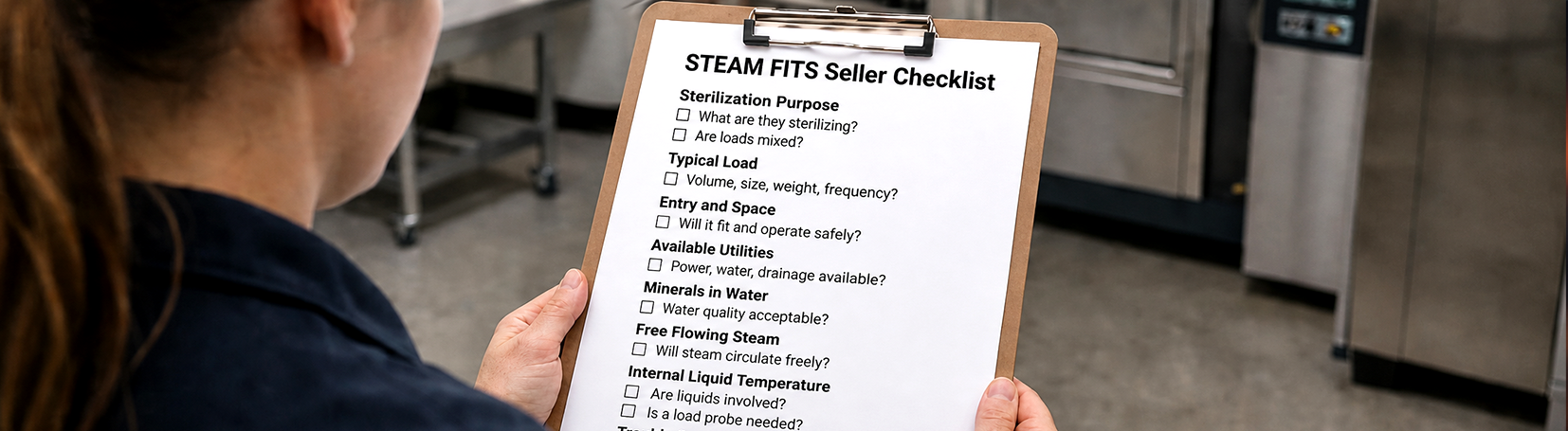
Sterilization Purpose
What are they sterilizing?
Are loads mixed?
Typical Load
Volume, size, weight, frequency?
Entry and Space
Will it fit and operate safely?
Available Utilities
Power, water, drainage available?
Minerals in Water
Water quality acceptable?
Free Flowing Steam
Will steam circulate freely?
Internal Liquid Temperature
Are liquids involved?
Is a load probe needed?
Trouble Spots
Any risk of operator error?
Service and Support
Who maintains and validates the unit?
Getting the Best Results from Your Autoclave
The following topics do not fall neatly under a single STEAM FITS heading, but they are directly relevant to customer success and long-term autoclave performance.
Cleaning and Maintenance
Regular cleaning is essential to maintaining autoclave performance and extending the life of the equipment. The chamber interior, door seal, drain strainer, and water reservoir should all be inspected and cleaned at regular intervals according to the manufacturer's schedule.
Scale deposits on the chamber walls, heating elements, and drain components should be removed using an appropriate descaling agent. The frequency required depends on local water hardness and cycle volume — sites in hard water areas or with high cycle throughput will need more frequent descaling than low-use sites in soft water areas.
The door seal (gasket) is a wear item and should be inspected at every service for signs of compression set, cracking, or weeping. A failing door seal will cause the autoclave to struggle to reach or hold pressure, leading to extended or failed cycles. Door seals should be replaced proactively during planned maintenance rather than waiting for a failure.
Record Keeping
Accurate record keeping is a fundamental part of responsible autoclave operation, and is a regulatory requirement in many settings. At a minimum, operators should record:
- The date and time of each cycle
- The cycle programme used
- The nature of the load (load type, approximate volume)
- The cycle outcome (completed successfully, failed, aborted)
- Any anomalies or alarms observed during the cycle
- The operator's name or identifier
Many modern autoclaves have integrated data logging and printing capability that can generate a printed or electronic cycle record automatically. Where this is available, it should be used. Where it is not, a manual logbook is required. Cycle records should be retained in accordance with local regulatory requirements and the organisation's own quality management procedures.
Storage of Waste Prior to Autoclaving
Waste that is awaiting autoclaving must be stored safely and in a manner that minimises risk to personnel. Key considerations include:
- Biohazardous waste should be stored in appropriate, clearly labelled autoclavable bags or containers, away from general waste
- Storage time between generation and autoclaving should be minimised, particularly for clinical or infectious waste, to reduce the risk of secondary contamination or bag degradation
- Overfilled bags should not be stored — fill to no more than two-thirds full to allow for safe handling and effective autoclaving
- Storage areas should be secure, appropriately ventilated, and accessible only to authorised personnel
Autoclave Calibration: A Closer Look
Calibration of an autoclave's temperature and pressure measurement system is a distinct process from routine maintenance, and it is worth customers understanding the difference.
During calibration, a trained engineer brings calibrated reference instruments — themselves traceable to national measurement standards — and connects them to the autoclave alongside the autoclave's own sensors. A series of test cycles are run, and the readings from the autoclave's sensors are compared against the reference instruments across the operating temperature and pressure range. Any discrepancy is documented, and if it exceeds the permitted tolerance, the sensor is adjusted, repaired, or replaced until agreement is achieved.
The output of a calibration exercise is a calibration certificate that states the measured deviation of the autoclave's sensors from traceable reference standards. This certificate is the foundation of the autoclave's process records — it is what makes a logged temperature reading legally and scientifically defensible.
Calibration should be carried out at least annually, or more frequently if required by the site's quality management system, regulatory framework, or following any repair that may have affected sensor accuracy.
