Astell has been helping organisations achieve effective steam sterilization for more than 140 years. Over that time, we have learned that plant and agricultural research brings loads that are big, wet and heavy, often with a biosafety dimension on the way back out — and that a single institute may run many autoclaves across its departments to keep up. This article draws on lessons from anonymised plant-science research installations.
The challenge: volume in, controlled biology out
The loads in plant and agricultural research are often bulky — trays of growth media, bags of soil or compost, plant material — and there is frequently a biosafety dimension on the return leg, because genetically modified or quarantine material has to be decontaminated before it can leave containment.
Why a large square chamber earns its place
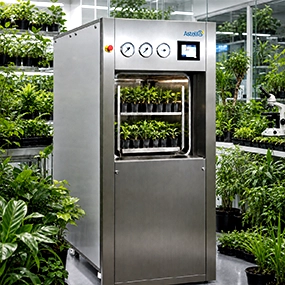
A square vessel makes better use of its volume than a cylinder for trays and containers, and the extra capacity suits an institute preparing media and sterilizing substrate in quantity rather than in ones and twos. One research configuration used a chamber a metre deep and 600 mm square precisely for this kind of bulk work.
What actually goes through them
In practice the load these institutes get through in the greatest volume is waste: spent soil and compost, and used plant material, decontaminated before disposal — often collected in dedicated bins or boxes and run in bulk, day after day. Alongside it sits routine growth-media preparation and glassware. And it is rarely one machine’s work: a large plant-science institute may run a dozen or more autoclaves across its departments, each carrying a share of that media-and-soil-waste rhythm.
Two duties worth specifying together
Preparing growth media and sterilizing substrate is a routine, high-volume job. Decontaminating GM or contained plant material is a biosafety job, where the priority is confidence that a bulky, sometimes dense load has been fully inactivated before disposal — which puts the emphasis on thorough air removal and steam penetration, and on a cycle robust enough for the load.
A typical arrangement would be trays of growth media on a 121°C cycle held for 15 minutes — with a lower cycle, around 115°C, kept for heat-sensitive media — and spent soil and plant waste taken through a longer, more robust decontamination cycle, using negative pulsing to clear trapped air from a dense load and held at 121°C or above, before it leaves the facility.
What this means for research institutes
The practical priorities are capacity and confidence — a chamber big enough to keep the science supplied, and cycles dependable enough to satisfy both the research and the biosafety side of the house.
How Astell can help
In this type of application, Astell can help research institutes size a square-section chamber and specify cycles for both high-volume media work and contained-waste decontamination. If you have a similar challenge, or another autoclave-related question, contact Astell to discuss it. With hundreds of autoclaves available, highly customisable builds, versatile installation options and an expert team of in-house service engineers, Astell has the skills and experience to help solve your steam sterilisation challenges. Contact Astell today at Info@Astell.com.