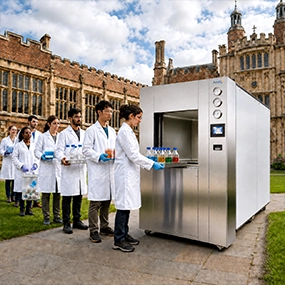
Astell has been helping organisations achieve effective steam sterilisation for more than 140 years. Over that time, we have learned that a combined teaching-and-research laboratory asks more of a single autoclave than almost any other setting. This article draws on lessons from anonymised academic installations, where the same machine has to serve both a class of students and a research group’s exacting standards.
The challenge: one machine, two very different jobs
A university microbiology lab is a place of extremes. One morning it is feeding a class of undergraduates their first agar plates; that afternoon it is supporting a research project that cannot afford a single contaminated flask. The same autoclave serves both, and it rarely gets a quiet day.
Why a shared lab leans on a front-loader
Across academic installations the pattern is consistent: the dominant job is media preparation, backed by general glassware and the safe disposal of teaching and research waste. A university lab tends to run a front-loading autoclave for exactly this reason — a comfortable working height, room for stacked media bottles and glassware, and the throughput to keep both teaching and research supplied without becoming the thing everyone queues behind. Where media-preparation volume is genuinely high, that can step up to a large square-section chamber: one academic installation paired a top-loading unit with a 420-litre square-chamber autoclave precisely to prepare media and sterilise glassware at the scale a combined operation gets through.
Two features that earn their keep
The first is stored programmes: a machine that holds and recalls distinct cycles lets one unit switch cleanly between melting and pouring media, sterilising glassware, and decontaminating waste, with no re-programming between jobs — which matters when several people share it. The second is simple, repeatable operation, because in a teaching lab the operator changes constantly and the machine has to behave the same way for everyone.
A typical arrangement would be culture media in vented bottles on a 121 °C cycle held for 15 minutes, with a lower cycle — around 115 °C — kept for heat-sensitive media, alongside a separate discard cycle for used plates and gloves from teaching classes, taken to 121 °C or above and held longer to deal with a mixed, densely-packed load. In practice the load mix at a busy university is exactly that broad — Duran bottles, petri dishes and plates, pipette-tip boxes, universals, gloves and tissue all pass through the same lab — and at a large institution it is spread across many machines: it is not unusual for a single university to run well over a dozen autoclaves across its departments.
What this means for university labs
For a busy department the real win is dependability under mixed demand — a chamber sized to the weekly rhythm of teaching and research, straightforward enough for a rotating cast of users, and reliable enough that neither a lab class nor a research deadline waits on the autoclave.
How Astell can help
In this type of application, Astell can help academic laboratories match autoclave format, capacity and stored-cycle setup to a shared teaching-and-research workload. If you have a similar challenge, or another autoclave-related question, contact Astell to discuss it. With hundreds of autoclaves available, highly customisable builds, versatile installation options and an expert team of in-house service engineers, Astell has the skills and experience to help solve your steam sterilisation challenges. Contact Astell today at Info@Astell.com.